
You Don't Need to Rip and Replace Anything – or Expand your Team
Before You Buy a Refrigeration Management Solution, Ask These 6 Questions
We hear a common myth when speaking to procurement teams about refrigeration management solutions: that adopting a new optimization platform requires overhauling your existing tech stack. It doesn't. But some vendors have built their entire business model on convincing you otherwise. That should raise a red flag.
The right solution integrates with what you already have: your controllers, your CMMS, your refrigerant tracking system, your contractors, your workflows, and most importantly, your existing team. If a vendor can't meet that standard, the risk isn't just a painful implementation. You trade away flexibility, invite vendor lock-in, and create entirely new compliance exposure.
Before you sign anything, ask the six questions below.
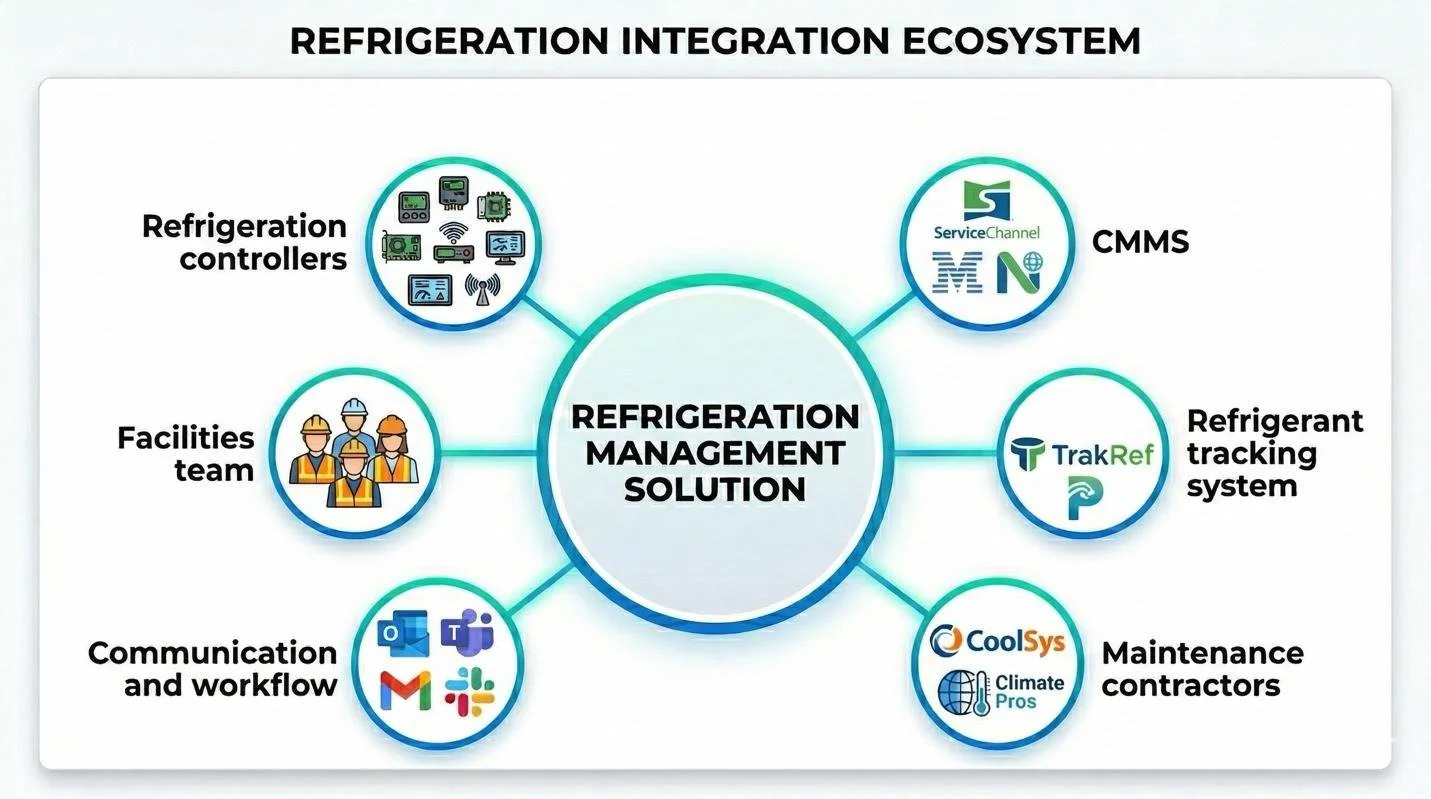
A best-in-breed refrigeration management platform connects to your existing ecosystem and workflow —
no rip-and-replace required.
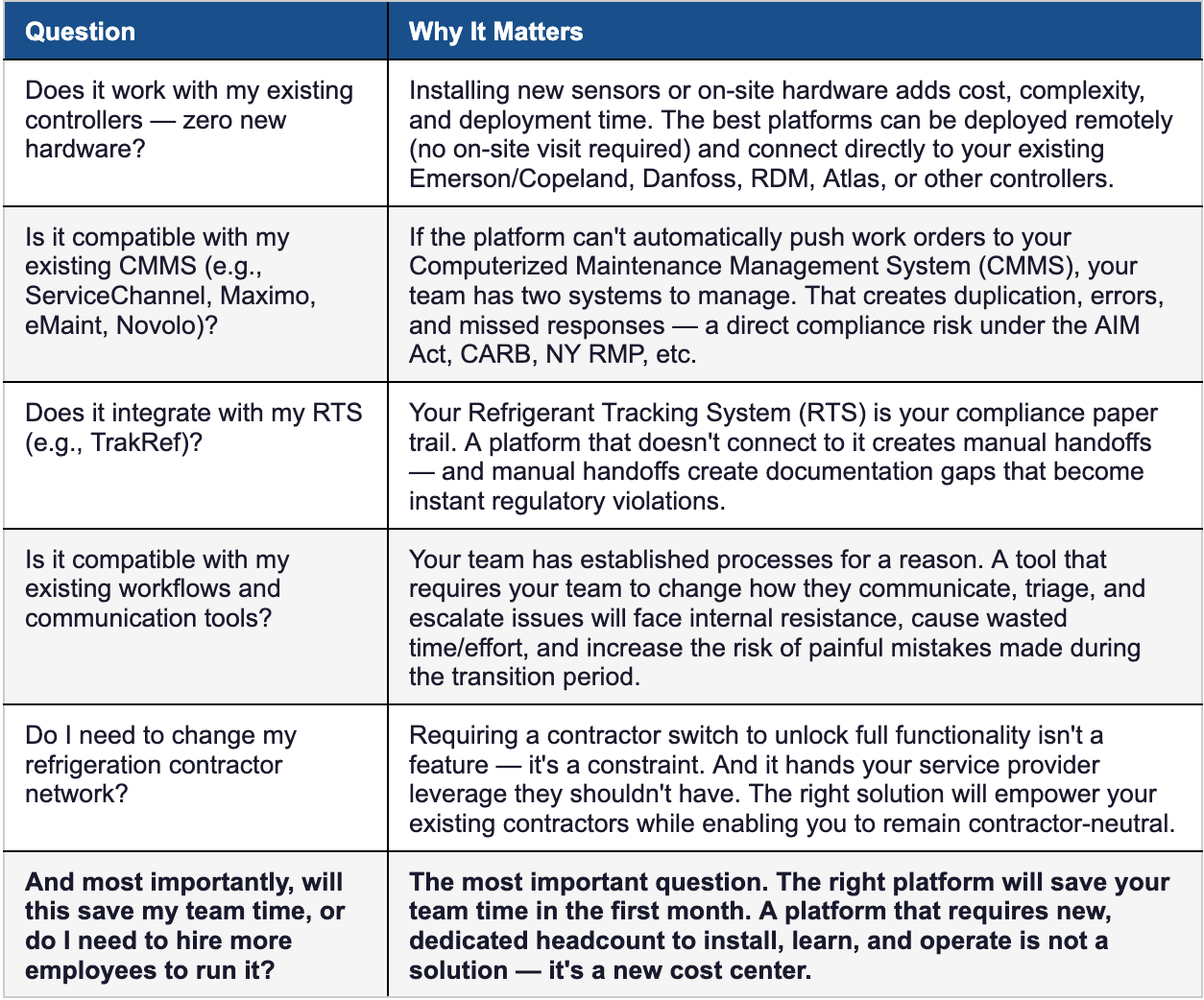
The 6 Questions Every Buyer Should Ask
The answers to these questions will determine not just how painful your rollout will be — but also how much value you actually get after going live.
The "Fox in the Henhouse" Problem
A major refrigeration equipment and services company has expanded into refrigeration management software. Their platform is marketed as a compliance and optimization tool for grocery retailers. It's a credible product — built on over a century of refrigeration experience and a nationwide field service organization.
But that field service organization is the problem.
When the same company that sells you refrigeration management software is also your maintenance contractor, you have a fundamental conflict of interest. Your optimization platform exists, in part, to hold your contractor accountable: tracking first-time fix rates, flagging recurring anomalies, monitoring response times, and dispatching “call-backs” to address unresolved issues. If the maintenance contractor also owns the refrigeration management software, who holds them accountable?
We've heard directly from customers who experienced exactly this dynamic, including multiple enterprise grocery retailers. Insights that should have triggered faster action were deprioritized. Issues were explained away rather than resolved. The platform that was supposed to police the contractor became a tool the contractor managed in their own interest.
“An effective approach to lowering emissions rates and operational cost is to implement [our software’s] early leak detection tools for customers with service agreements.”
Read that carefully. The software is positioned primarily as a tool to support their own service agreements — not as an independent platform built for the end user's benefit. That framing is a tell.
A third-party refrigeration management solution has no stake in who does the maintenance work or how often a truck rolls. Its only incentive is to help the end-user achieve results by surfacing the precise nature of every anomaly, how long it's been active, what it will cost if ignored, how it should be prioritized in the context of everything else, and whether the last repair actually fixed the root cause.
That independence is not a nice-to-have. It's the entire point.
It Gets Worse When a Third-Party Contractor Is Involved
The conflict-of-interest problem doesn't disappear when a different contractor is doing the maintenance work. In many cases, it gets worse.
Other independent refrigeration contractors often view large “equipment + maintenance contractor + refrigeration management solution” conglomerates as a direct competitor. Many contractors justifiably view any interaction with the competitor's software as a threat to their business. As a result, there is a lack of trust by the contractor in any insights delivered by the competitor's software, as the contractor often believes that the competitor is trying to make the contractor look bad. Put simply: When that competitor's software is generating work orders in your store, those contractors have little incentive to take the platform's insights seriously.
We've heard this firsthand. Technicians push back on alerts and work orders are closed without proper resolution. The result: your compliance documentation has gaps, your equipment degrades faster than it should, and the ROI you were promised never materializes.
“The bottom line: a refrigeration management platform built by a company with financial interests in your service market cannot be fully trusted to act as an objective arbiter of equipment health — regardless of how good the technology claims to be.”
The One-Stop-Shop Trap: Vendor Lock-In
There's a second trap worth addressing. Some vendors in this space take a different approach: instead of owning your service contractors, they want to own your entire technology stack.
The pitch sounds compelling — one platform to replace your CMMS, your refrigerant tracking system, and everything in between. A consequence of selecting this type of vendor is that you lose the ability to choose the “best-in-class” solution in each category. Instead you are settling for an “ok” solution across multiple categories.
One vendor in the refrigeration management solution space stated it plainly in their own press release:
“We’re thrilled to lead this transition as we continue to help enterprises replace multiple siloed tools with one comprehensive operations platform.”
That's not a value proposition. It’s a massive migration burden, with you absorbing all the risk. In addition,
The reality is a multi-year migration that consumes your facilities team's bandwidth, disrupts existing workflows, and creates significant switching risk. Companies have invested millions in systems like ServiceChannel, Maximo, or TrakRef. Their teams have built processes around these tools. Tearing them out to unify around a single vendor with average features and capabilities is not simplification — it's leverage.
Once you're fully migrated onto a closed platform, your switching cost is enormous. Every future pricing increase, every feature gap, every outage — you absorb it, because leaving is too expensive. That is vendor lock-in by design.
True flexibility requires the opposite approach: a refrigeration management solution layer that connects to your existing CMMS and RTS rather than replacing them. You keep the freedom to switch your CMMS if ServiceChannel raises vendor fees. You keep your preferred contractor. Most importantly, you maintain the ability to evaluate and adopt better tools as the market evolves.
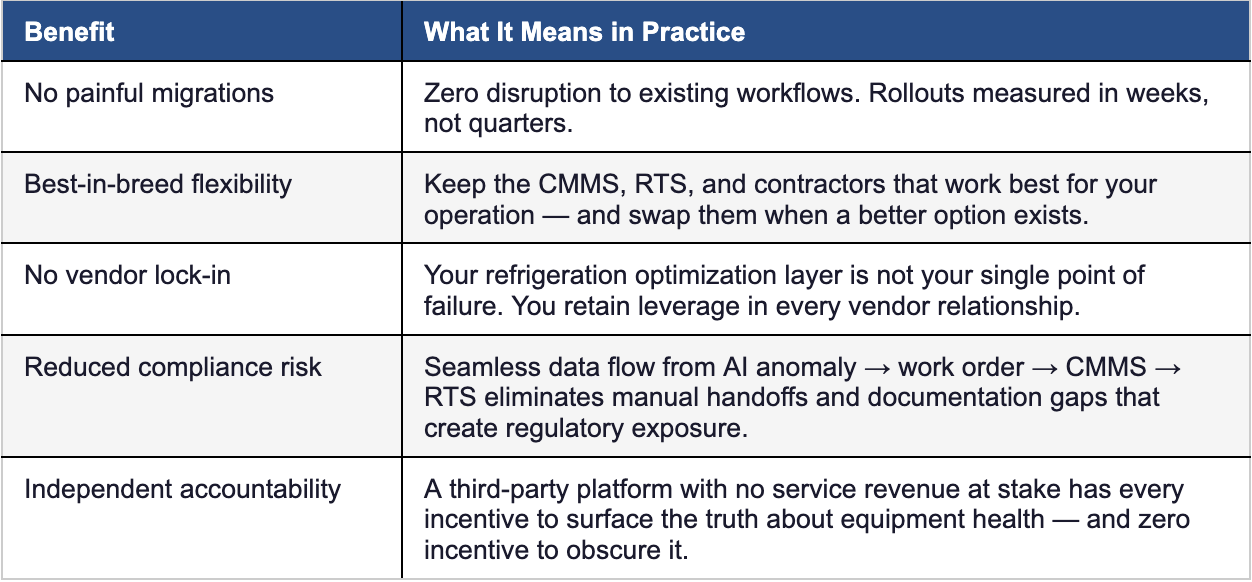
What You Gain When Integration Is Done Right
How Axiom Cloud Integrates With Your Existing Stack
Axiom connects to your existing refrigeration controllers — Emerson/Copeland, Danfoss, Micro Thermo, and others — without requiring any new onsite hardware, sensors, or computers. Our AI is trained on 1,200 site-years of refrigeration data and 110,000+ labeled anomalies, and it begins surfacing actionable insights within weeks of go-live.
When an anomaly is detected, Axiom automatically pushes a prioritized, information-rich work order to your existing CMMS that is properly prioritized and batched, based on your preferences. Axiom’s team of US-based refrigeration specialists are available to work with your team as repairs are completed (which helped Axiom’s customers rapidly resolve the root cause of 70% of all predictive anomalies sent in 2025). When the repair is completed, the resolution syncs back to your RTS for automated compliance documentation. Your team works in the tools they already know. Your contractors receive work orders from the same channels they are used to — just better ones, with full diagnostic context, delivered before the stressful emergency occurs.
Real-World Example: What Customer Tech Stacks Look Like
Axiom customers don't share a single technology environment — and they don't need to. The diagram below shows examples of the existing infrastructure combinations that Axiom integrates with today:
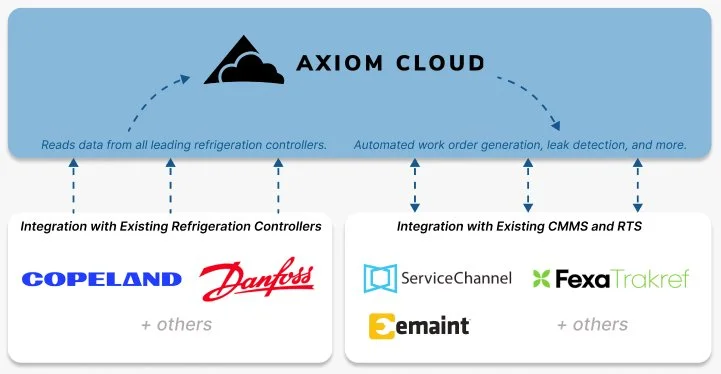
Current state vs. future state: Axiom adds an intelligent layer on top of your existing infrastructure — no replacement required.
The Bottom Line
The next time a vendor tells you their refrigeration management platform requires replacing your CMMS, switching your RTS, hiring more employees, changing your workflows, or replacing your contractor network — ask yourself who benefits from that requirement.
The right platform makes your existing team, tools, and contractors more effective. It doesn't replace them. It doesn't compete with them. And it doesn't hold your operations hostage.
If you're evaluating refrigeration management solutions and want to see how Axiom integrates with your existing infrastructure, reach out directly: amrit@axiomcloud.ai
Amrit Robbins is the CEO and Co-Founder of Axiom Cloud. Axiom Cloud's AI-powered refrigeration management platform is used by national grocery retailers and cold storage operators to reduce refrigerant leaks, cut energy costs, and achieve compliance with EPA AIM Act and CARB regulations — without new hardware or changes to existing infrastructure.